
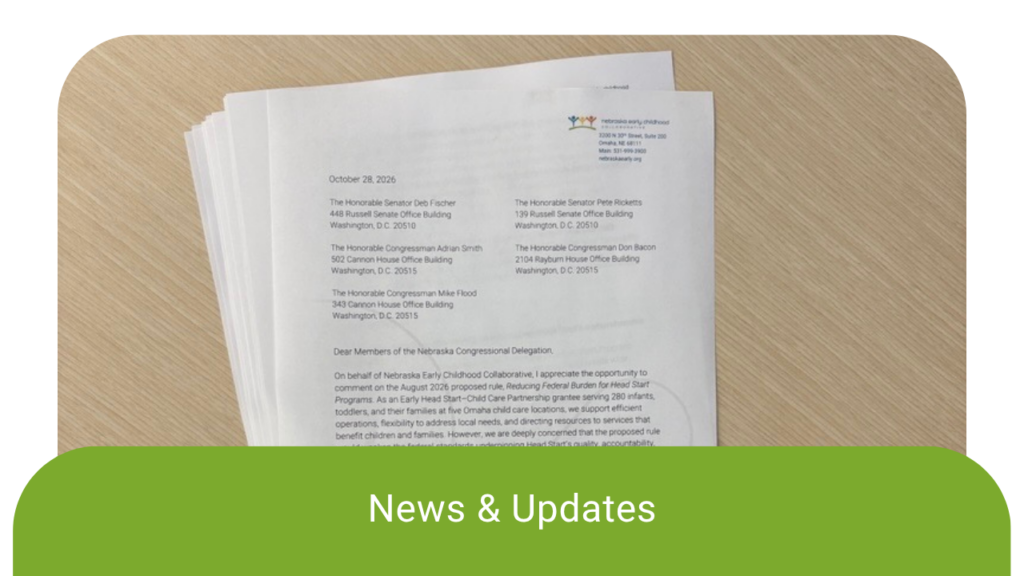
October 28, 2026
The Honorable Senator Deb Fischer
448 Russell Senate Office Building
Washington, D.C. 20510
The Honorable Senator Pete Ricketts
139 Russell Senate Office Building
Washington, D.C. 20510
The Honorable Congressman Adrian Smith
502 Cannon House Office Building
Washington, D.C. 20515
The Honorable Congressman Don Bacon
2104 Rayburn House Office Building
Washington, D.C. 20515
The Honorable Congressman Mike Flood
343 Cannon House Office Building
Washington, D.C. 20515
Dear Members of the Nebraska Congressional Delegation,
On behalf of Nebraska Early Childhood Collaborative, I appreciate the opportunity to comment on the August 2026 proposed rule, Reducing Federal Burden for Head Start Programs. As an Early Head Start–Child Care Partnership grantee serving 280 infants, toddlers, and their families at five Omaha child care locations, we support efficient operations, flexibility to address local needs, and directing resources to services that benefit children and families. However, we are deeply concerned that the proposed rule would weaken the federal standards underpinning Head Start’s quality, accountability, and comprehensive approach to early childhood development.
Head Start is a vital investment in children, families, and communities. For more than 60 years—and through Early Head Start since 1994—the program has connected young children experiencing economic hardship with early learning, health and developmental services, nutrition, family engagement, and essential community resources. Its strength lies in a comprehensive model that helps ensure children’s present circumstances do not determine their opportunities for future success.
We align with the National Head Start Association’s position that any final rule must meet three core commitments in order to keep the promise of Head Start:
- Do not make it harder for children and families with the greatest needs to access Head Start. Head Start exists to serve the children and families who need it most, and any provision that makes it harder for families to access or remain enrolled in Head Start would move the program away from its core purpose.
- Do not let regulatory changes erode the stability and resources programs of all sizes need to deliver high-quality services. Rules that appear to reduce paperwork must not result in resource reductions, instability, or unfunded mandates in practice, particularly for small and rural programs with fixed compliance and operating costs.
- Give programs meaningful flexibility to determine how best to serve their communities. A strong national program should establish a clear floor for quality and accountability while ensuring that flexibility is not undermined through monitoring, grant negotiations, allowable-cost decisions, or other administrative actions.
We strongly urge ACF to:
1. Preserve strong federal quality standards and protect Head Start’s comprehensive services model.
We are concerned that substantially reducing or rescinding the Head Start Program Performance Standards in favor of state and local requirements could create wide disparities in service quality and scope. Federal standards provide a consistent foundation and help ensure that children facing poverty, developmental delays, disabilities, housing instability, or other challenges receive reliable support.
Our Early Head Start-Child Care Partnership program serves children and families who often face multiple barriers to opportunity. Access to safe, developmentally appropriate, high-quality early learning should not depend on a child’s location or local regulations. To this end, we are particularly concerned about eliminating developmental screening and assessment requirements. Because development progresses rapidly during the first five years, early identification is essential for timely intervention. At our Early Head Start–Child Care Partnership sites, teachers and support staff regularly connect children to screenings and services when they identify a potential disability. The earlier children receive services, the greater the opportunity to support their development. Strong federal standards promote consistency and help ensure that children receive appropriate support regardless of local resources.
States play an important role in early childhood systems, but licensing requirements do not necessarily address the full scope of Head Start’s mission. Licensing sets baseline standards for operating child care programs, while the Head Start Program Performance Standards support a comprehensive model of early learning, family partnership, child development, and school readiness.
2. Maintain appropriate administrative resources and reject an inflexible administrative cost cap.
As stewards of taxpayer dollars supporting our Early Head Start-Child Care Partnership program, we are committed to responsible use of federal resources. This responsibility depends on strong administrative infrastructure, making the proposed reduction in the administrative cost cap of 15% to 5% particularly concerning. Administrative functions are integral to direct services and essential to safety, compliance, and sound financial management.
Strong administrative infrastructure is essential to recruiting and retaining qualified, background-checked staff; maintaining safe facilities; managing complex grants, financial records, audits, and oversight; and meeting fiscal reporting requirements. Reducing the allowable administrative cost cap without a comprehensive assessment of actual operating costs would strain programs and weaken critical quality controls. A sharply lower administrative cost cap would fall hardest on small and rural programs whose fixed costs for financial oversight, background checks, data security, and compliance are spread across fewer children.
3. Protect the Head Start workforce and the quality of classroom experiences.
Head Start’s success depends on a strong workforce. Teachers, family advocates, home visitors, health professionals, and other staff build relationships that support children’s learning, development, and long-term success. Staffing levels, qualifications, compensation, and professional development are not merely regulatory requirements; they directly affect the quality and consistency of services and staff shortages should not be resolved by weakening staffing, qualification, supervision, or teacher-to-child ratio requirements.
Workforce challenges should be addressed through investment, not lower standards of care. Strong ratios and group-size limits enable teachers to provide individualized attention, support children with disabilities and developmental or behavioral needs, and build meaningful family relationships. Federal policy should prioritize competitive compensation, professional development, recruitment, retention, and career pathways. Weakening staffing or professional preparation standards could further strain an already challenged early childhood workforce. Higher teacher-to-child ratios, inadequate staffing, and insufficient preparation can reduce individualized attention, particularly for children with disabilities, developmental delays, or significant social-emotional needs.
We urge ACF to preserve meaningful workforce standards and pair regulatory flexibility with investments in recruitment, retention, compensation, and professional development. Head Start programs must attract and retain skilled professionals who understand and reflect the communities they serve.
4. Preserve meaningful family engagement and parent leadership.
Parents are more than recipients of Head Start services; they are their child’s first and most important teacher and essential partners in their children’s education and development. Head Start was built on partnering with parents, creating space for parent voices, and allowing parents meaningful opportunities to influence program decisions. Family engagement and parent leadership are central to the Head Start model. They strengthen family–educator relationships, support children’s development, and help programs reflect the priorities and experiences of the communities they serve.
We are concerned that weakening family-engagement expectations could limit parents’ opportunities to participate in program governance, shape services, and build the leadership and advocacy skills that benefit them long after their children have aged out of Head Start. Strong family partnerships also help programs recognize emerging needs and address barriers to children’s participation and success. We recommend retaining clear requirements for meaningful family engagement, parent participation in program governance, and leadership development. Programs should have flexibility in how they engage families, but families must remain recognized as essential partners.
5. Protect access for vulnerable families.
Head Start serves families facing significant barriers, including homelessness, housing instability, poverty, and other crises. Eligibility and documentation requirements should protect program integrity without unnecessarily restricting access for eligible children. Families experiencing homelessness need immediate support during especially difficult periods, and eliminating attestations would create additional obstacles for those most in need. In the Omaha metropolitan area, many families also spend more than 30% of their income on substandard housing. Removing the flexibility to adjust household income based on housing costs would significantly affect the families we serve. Children and families facing the greatest challenges should not encounter further barriers to Head Start services.
6. Maintain inclusive, developmentally appropriate services for all children.
Head Start’s commitment to school readiness requires programs to serve children from diverse linguistic, cultural, and family backgrounds effectively. We are concerned that changes to instruction for dual language learners and children from diverse linguistic backgrounds could limit programs’ ability to provide responsive, individualized learning experiences. Children learn through relationships, communication, play, and meaningful interactions with adults. Supporting a child’s home language and cultural background strengthens family partnerships, while helping the child learn English supports early learning and development.
We urge the ACF to preserve federal protections and developmentally appropriate practices for dual language learners. Head Start should prepare every child for success while recognizing children may need different supports and pathways to achieve that goal.
Recommendations
Nebraska Early Childhood Collaborative respectfully recommends that HHS and ACF:
- Maintain strong federal standards for health, safety, education, staffing, and comprehensive services
- Uphold appropriate teacher-to-child ratios and group-size safeguards
- Safeguard services for children with disabilities and other specialized needs
- Sustain comprehensive health, nutrition, mental health, and family services
- Maintain meaningful family engagement and support for dual language learners
- Ensure access for families experiencing homelessness and other significant barriers
- Address workforce challenges through compensation, recruitment, retention, and professional development rather than lower standards.
- Reevaluate the proposed administrative cost cap
- Allow adequate transition time and provide technical assistance and clear guidance for significant regulatory changes
Head Start embodies a longstanding national commitment to ensuring that children and families experiencing economic hardship have the resources and opportunities to thrive.
We support efficient administration and appropriate local flexibility, provided these goals preserve Head Start’s core commitments to quality, comprehensive services, family partnership, and accountability. Children and families served by Head Start deserve an efficient, effective program that upholds the high standards essential to their health, development, and long-term success.
Administrative burden can be reduced, flexibility expanded, and programs modernized without compromising quality or protections. We urge HHS and ACF to revise the proposed rule while preserving the strong federal standards that protect Nebraska’s children and families and support the Head Start grantees serving them.
Thank you for considering our comments and allowing us to participate in this important rulemaking process.
Respectfully,
Christian Espinosa-Torres,
Board Chair
Jennifer Adhima,
Chief Program Officer
Sarah Ann Kotchian,
Chief Executive Officer
Milton Trabal,
Chief Financial Officer
Kristina Norwood,
Director of Early Head Start
Lameakia Collier,
Chief Operating Officer
About the Nebraska Early Childhood Collaborative
At the Nebraska Early Childhood Collaborative, we’re investing in the early childhood landscape through innovation, collaboration, and service – strengthening families, businesses, and Nebraska. Support our mission at nebraskaearly.org/donate